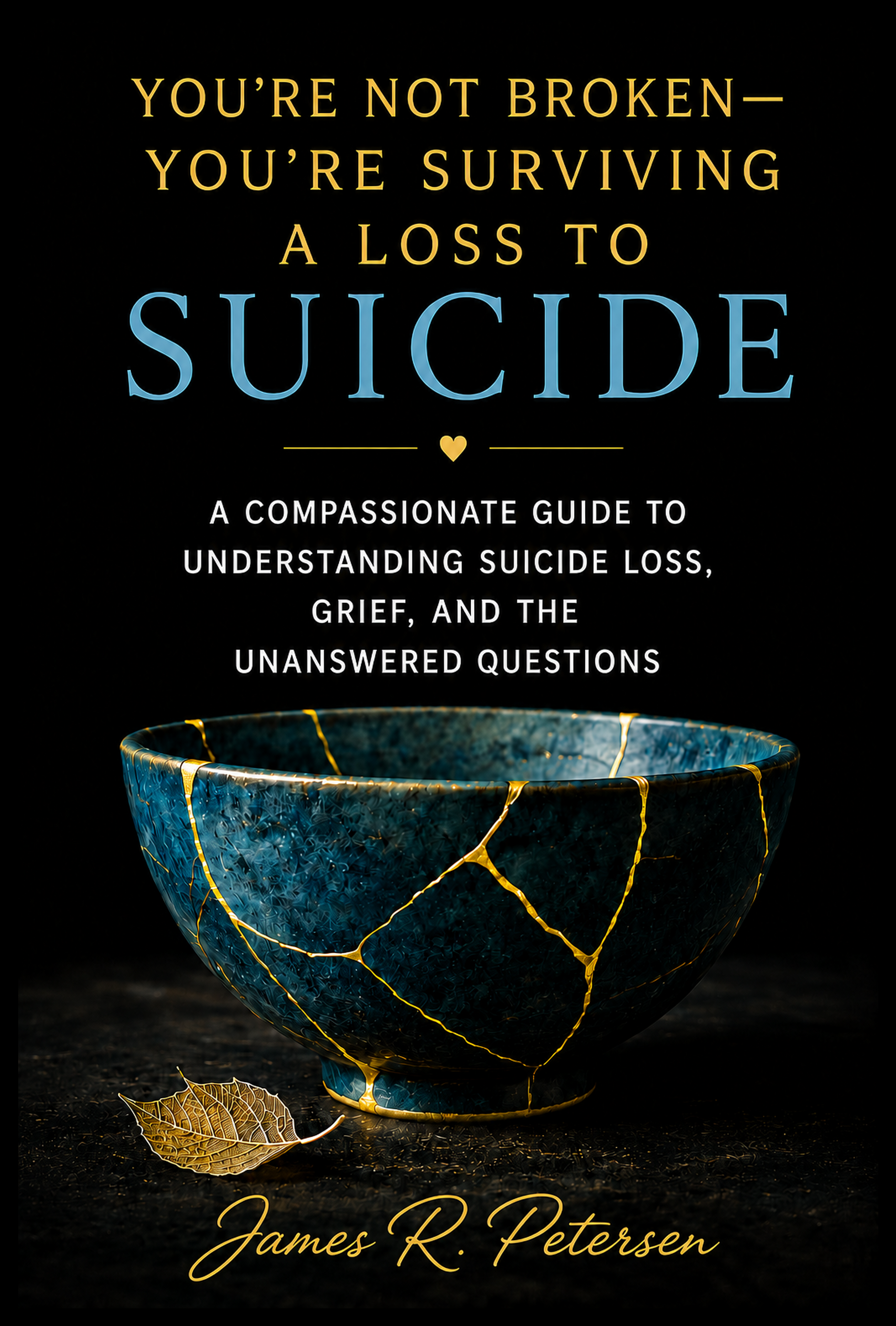
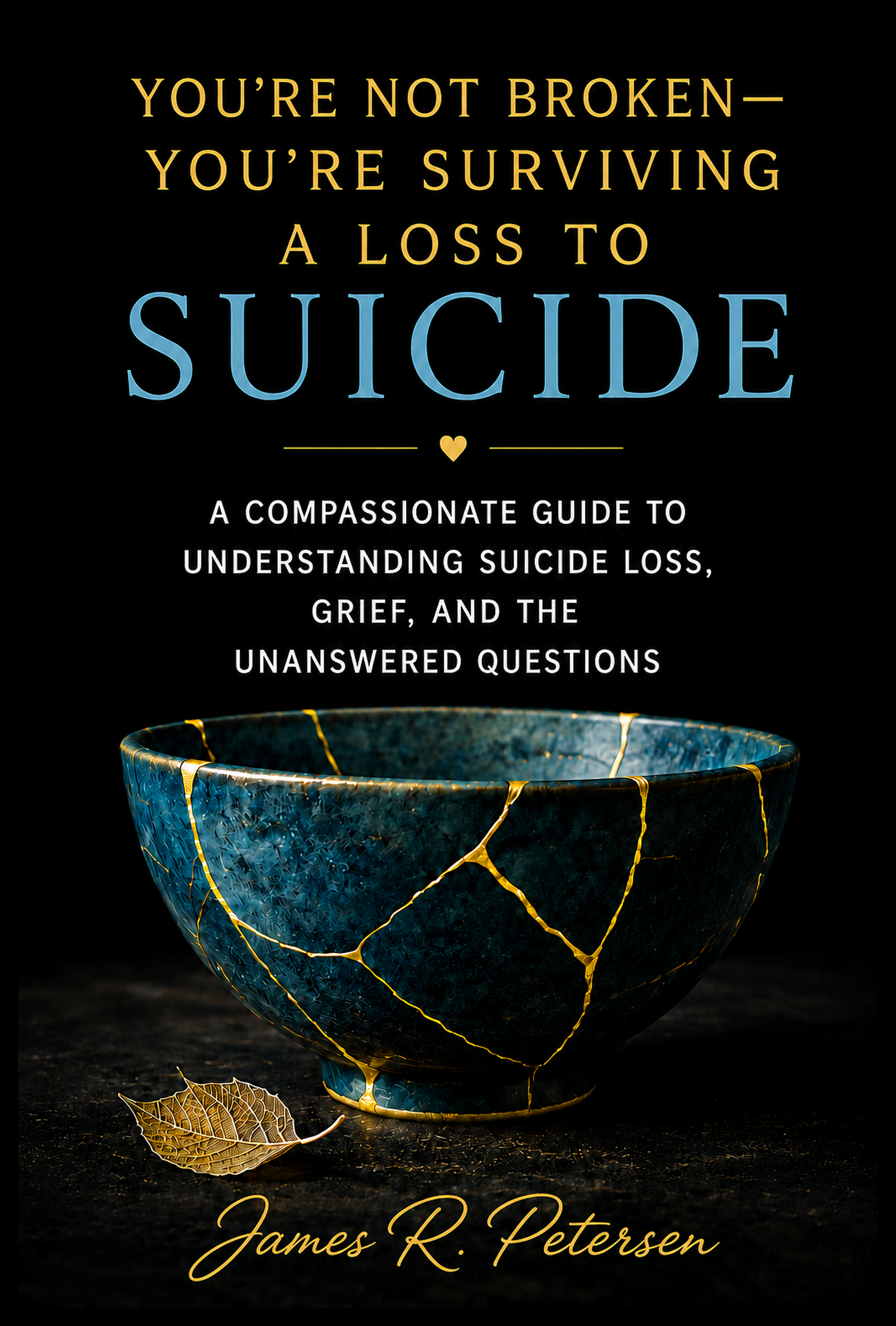
You’re Not Broken—You’re Surviving a Loss to Suicide
A Compassionate Guide to Understanding Suicide Loss, Grief, and the Unanswered Questions
When someone you love dies by suicide, grief is only part of what follows. Survivors may also carry shock, trauma, guilt, anger, stigma, relationship changes, and questions that may never have complete answers.
This companion page allows you to look inside the book before purchasing. You can review the complete table of contents, read a sample chapter, and explore selected sources and further reading.
Who This Book Is For
First and foremost, this book is for anyone whose life has been changed by a death by suicide. It is also intended for the people who support survivors personally, professionally, and within their communities.
For Survivors and Families
• People whose loss is recent and those who have carried it for many years
• Parents, spouses, partners, children, siblings, relatives, friends, and others affected by the death
• Families navigating trauma, stigma, conflict, strained relationships, and unanswered questions
• Survivors trying to understand how to carry the loss without allowing it to consume everything
For Those Who Support Them
• Friends, coworkers, neighbors, and community members who want to understand
• Suicide-loss support-group facilitators, clergy, and grief-support volunteers
• Counselors, therapists, social workers, educators, and healthcare professionals
• First responders, funeral professionals, victim advocates, and others called into suicide’s aftermath
Complete Table of Contents
The chapters are arranged in six parts, moving from the immediate shock of suicide loss through its many personal, family, and practical consequences—and toward the delicate permission to live again.
Select any section title below to view its chapters.
-
Preface
How This Book Came to Be
The Gold-Seamed Vessel
A Note About This Book -
6 When the Body Breaks
7 Navigating the “Messy Middle” of Suicide Loss
8 When a Child Dies by Suicide
9 When Belonging Feels Impossible
10 The Invisible Battle
11 Financial Collapse
12 Legal Jeopardy
-
6 When the Body Breaks
7 Navigating the “Messy Middle” of Suicide Loss
8 When a Child Dies by Suicide
9 When Belonging Feels Impossible
10 The Invisible Battle
11 Financial Collapse
12 Legal Jeopardy
13 The Weary Body 1
4 The Scheduled Farewell
5 Treatment-Resistant Mental Illnesses
-
16 When Suicide Hits Home
17 The Physical Realities of PTSD and Survivor Shock
18 Images You Can’t Unsee
19 Those Who Walk Into the Storm
20 When Grief Meets the Law
21 The Battle Over the Verdict
22 The Anatomy of a Note—or No Note
23 Facing the Reactions of Others
-
24 Could I Have Prevented It?
25 When Love Isn’t Enough
26 Will I Ever Know Why?
27 Am I Allowed to Be Angry?
28 Why Can’t I Cry?
29 Has Suicide Infected My World?
30 Will It Happen Again?
-
40 Rebuilding the Shattered Bowl
41 The Companion’s Lantern
Sample Chapter
5
Across Time and Culture
Dismantling Myths and Stigma
Through many lands and distant years,
We've shared the same enduring tears.
Though customs change from place to place,
Compassion still becomes our grace.
When someone dies by suicide, families often discover they are carrying far more than grief alone. Along with the shock of the loss come awkward silences, uncomfortable questions, whispered conversations, and, for many, an unexpected sense of shame. Those reactions can feel so immediate and so widespread that it is easy to assume they are simply part of human nature.
History tells a different story.
The attitudes surrounding suicide have changed dramatically across centuries, cultures, and belief systems. Some societies viewed it as an act of honor under limited circumstances. Others condemned it as both a crime and a sin. Some punished the surviving family as severely as the person who died. Others gathered around survivors with compassion and support. There has never been one universal understanding of suicide.
That realization is surprisingly liberating. If beliefs about suicide have varied so dramatically across time and cultures, then many of the judgments people carry today are not timeless truths. They are inherited ideas—ideas shaped by history, religion, politics, law, and culture.
This broader perspective cannot remove your grief. It can, however, begin lifting a burden that many survivors never realized they were carrying. Understanding where stigma came from helps us recognize that it is not an unavoidable part of suicide loss. It is something human beings created—and something human beings can change.
How Attitudes Changed
Human beings have struggled to understand suicide for thousands of years. Although the act itself has existed throughout recorded history, the way societies have interpreted it has changed dramatically. Every culture has attempted to answer the same difficult questions: Why would a person choose death? Who has authority over human life? How should the community respond? The answers have varied remarkably, reflecting the beliefs, values, and needs of each civilization.
In many of the earliest civilizations, suicide was viewed pragmatically rather than morally. Ancient Egypt, Mesopotamia, Greece, Rome, India, China, and many Indigenous cultures each developed their own understanding. Some regarded it as an honorable response under extraordinary circumstances. Others accepted it as a deeply personal decision. Still others viewed it as a disruption to the harmony of the community or the spiritual world. There was no single, universal understanding.
As history unfolded, several broad perspectives emerged:
Honor and Duty. In some societies, suicide was accepted under extraordinary circumstances as an act of honor, personal responsibility, or sacrifice. Japanese samurai practiced seppuku as a ritual of honor. Some Roman Stoic philosophers believed that when dignity, liberty, or unbearable suffering could no longer be preserved, a person had the right to choose their own death.
Compassion for Suffering. Ancient Greek society often recognized that unbearable physical illness or irreversible suffering created difficult moral questions. In some city-states, individuals could petition civic authorities for permission to end their lives under carefully defined circumstances.
Religious and Moral Prohibition. As Christianity became the dominant influence throughout medieval Europe, suicide increasingly came to be viewed as both a sin against God and a crime against society. Similar prohibitions developed within other religious traditions, although each interpreted them somewhat differently.
Criminalization and Punishment. During much of the Middle Ages and well into later European history, suicide was punished not only through religious condemnation but also through civil law. Families sometimes lost property, burial rights, or social standing. Some communities even placed the deceased on trial or denied them traditional funeral rites.
The Modern Medical Perspective. Over the past two centuries, advances in psychology, psychiatry, and neuroscience have gradually shifted much of the world's understanding. Today, many countries increasingly view suicide not as a crime or moral failure, but as the tragic outcome of overwhelming psychological pain, mental illness, trauma, or other complex life circumstances.
None of these perspectives tells the entire story, nor did any of them exist in complete isolation. Different cultures often held competing beliefs at the same time, and those beliefs continued to evolve over generations. What history teaches us is not that one era possessed all the answers, but that humanity has always struggled to understand one of life's most painful realities.
The Weight of Inherited Beliefs
Most of us rarely stop to ask where our beliefs about suicide came from. They often feel so familiar that we assume they have always existed. Yet many of the thoughts that flood our minds after a suicide were shaped long before we were born. They were passed from generation to generation through families, religious traditions, laws, literature, and the culture in which we were raised.
When a loved one dies by suicide, those inherited beliefs often rise to the surface without our even realizing it. We may find ourselves wondering whether they were condemned, whether they somehow failed morally, whether our family should feel ashamed, or whether others are quietly judging us. Sometimes these thoughts come from our own deeply held convictions. Other times they simply reflect ideas we absorbed over a lifetime without ever examining them closely.
History helps us recognize that many of these beliefs are inherited rather than inevitable.
Some originated in religious traditions.
Some developed through civil law.
Some were shaped by cultural expectations.
Some grew from fear, misunderstanding, or limited medical knowledge.
Others reflected genuine attempts to make sense of an event that has always challenged human understanding.
Recognizing the origins of these beliefs does not require us to abandon our personal faith or convictions. Rather, it invites us to ask thoughtful questions. Which beliefs continue to offer wisdom and comfort? Which may have arisen from fear or misunderstanding? Which help us carry our grief more gently, and which add burdens that were never intended to be ours?
For many survivors, this broader perspective becomes surprisingly freeing. We begin realizing that some of the shame we carry was never created by our own experience. It was inherited. And while grief cannot simply be set aside, inherited shame can be examined, questioned, and, sometimes, gently laid down.
Stigma Leaves a Long Shadow
Although much has changed over the past century, remnants of those earlier beliefs still remain. They may no longer appear in the form of criminal laws or public condemnation, but they often survive in quieter ways. Families may avoid talking about the death. Friends may become uncomfortable or uncertain about what to say. Some survivors hesitate to tell others how their loved one died, fearing judgment, awkward silence, or well-intentioned but hurtful comments.
Many people are surprised by how isolated they feel after a suicide loss. Unlike other forms of bereavement, suicide often leaves survivors wondering whether they should explain the circumstances of the death or quietly avoid the subject altogether. Some become exhausted by answering questions. Others become exhausted trying to avoid them. Neither response is unusual.
Stigma can appear in many subtle forms:
Conversations that suddenly stop when suicide is mentioned.
People avoiding the subject because they are afraid of saying the wrong thing.
Oversimplified explanations that fail to recognize the complexity of suicide.
Assumptions that someone must be to blame.
Feeling pressure to protect the family's reputation or privacy.
Quietly believing that your grief is somehow different from everyone else's.
Ironically, most of these reactions do not arise from cruelty. They arise from discomfort. Suicide confronts people with questions that have challenged humanity for thousands of years. When people feel uncertain, they often become silent. That silence, however, can unintentionally deepen the loneliness of those already carrying an overwhelming loss.
Understanding the history of stigma does not make those moments disappear. It does, however, help explain why they occur. The awkwardness many survivors encounter is not simply a reflection of their loved one's death. It is also part of a much older story—a story shaped by centuries of fear, misunderstanding, moral debate, and changing cultural beliefs. Recognizing that larger story allows us to take those reactions a little less personally and to respond with greater understanding, both for ourselves and for others.
A More Compassionate Understanding
One of the encouraging lessons of history is that human understanding is never frozen in time. Just as our knowledge of medicine, psychology, and human behavior has grown, so has our understanding of suicide. Ideas once accepted without question have been challenged. Assumptions have been reconsidered. Compassion has increasingly replaced condemnation, and understanding continues to replace fear.
That does not mean every difficult question has been answered. It has not. People of sincere faith, dedicated researchers, mental health professionals, philosophers, and families who have experienced suicide firsthand still disagree about many aspects of this profoundly complex subject. That diversity of thought reminds us that humility remains one of our greatest teachers.
Perhaps history leaves us with several enduring lessons:
Human understanding continues to grow.
Simple explanations rarely survive careful examination.
Compassion has gradually replaced many earlier judgments.
Every culture has struggled to make sense of suicide.
We are still learning.
Perhaps that is the greatest gift history offers those surviving a loss to suicide. It reminds us that we are not the first generation to wrestle with these questions, nor will we be the last. Others before us have searched for understanding, challenged old assumptions, and gradually widened humanity's perspective. We now become part of that same journey.
As our understanding deepens, something else often changes as well. We become less interested in assigning blame and more interested in understanding suffering. We become less certain that there is one simple answer and more willing to accept the extraordinary complexity of being human. In that sense, history does more than tell us where we have been. It quietly invites us to become more compassionate in where we are going.
What We Learned
Understanding history gives us perspective. It reminds us that many of today's attitudes toward suicide were shaped over centuries rather than arising from timeless truths.
There has never been one universal understanding of suicide. Different cultures, religions, and societies have interpreted it in remarkably different ways.
Many of the beliefs we hold about suicide were inherited rather than personally chosen. Understanding where they came from allows us to examine them more thoughtfully.
Stigma has a history. It developed through changing religious beliefs, legal systems, cultural traditions, and limited scientific understanding, leaving echoes that many families still experience today.
Most people's reactions to suicide arise from uncertainty rather than cruelty. Awkward silence, uncomfortable conversations, and oversimplified explanations often reflect discomfort with a subject that has challenged humanity for thousands of years.
History reminds us that human understanding continues to evolve. As our knowledge has grown, many societies have increasingly replaced condemnation with compassion and understanding.
Reflection
Perspective does not lessen our love or our grief. It simply reminds us that we are not the first people to wrestle with these questions. Across centuries and cultures, countless others have searched for understanding after a loss to suicide. Knowing that does not remove our pain, but it can make us feel a little less alone.
"The farther backward you can look, the farther forward you are likely to see." — Winston Churchill